
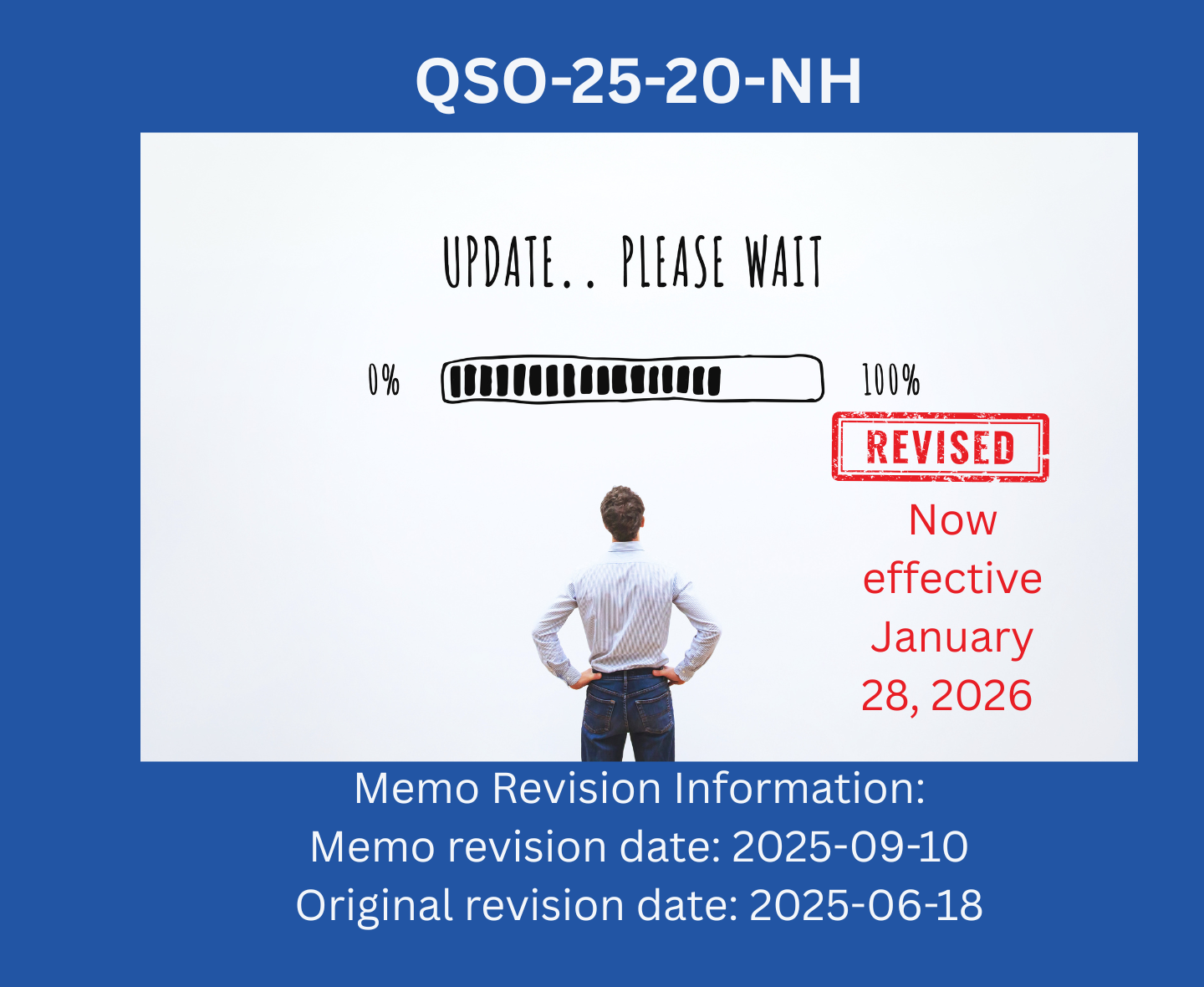

Click to access qso-25-20-nh-revised-2025-09-10.pdf
Ref: QSO-25-20-NH What does that mean for you as a MDS Assessment Coder coming in January?????
“CMS has a Revised timeline for incorporating the updated long-stay antipsychotic measure which is January 28th 2026.That is the date when CMS will incorporate the new measure on Nursing Home Care Compare. Currently the national percentage of residents receiving an antipsychotic is 14.64% under the existing measure. Under the new measure, this will increase to 16.98% due to the new measure’s inclusion of additional data, resulting in improved accuracy. This measure is one of several quality measures used to calculate the Nursing Home Care Compare Five-Star quality rating. The
updated measure will replace the current measure of the percent of long-stay residents receiving
an antipsychotic medication. For star rating calculations, the cut points for this measure will be
set to place providers into 10 equal deciles based on the distribution of providers’ performance.
For additional information on how CMS calculates star ratings, see the Nursing Home Care
Compare Five Star Technical Users’ Guide.”
How is this being Calculated?
“In 2021, the Office of Inspector General (OIG) reported that the use of the minimum data set
(MDS) for reporting the number of long-stay residents receiving antipsychotic medications may
not accurately reflect the number of residents who are prescribed antipsychotic medications. To
address this, CMS is updating the measure by including Medicare and Medicaid claims data and
Medicare Advantage encounter data to supplement MDS data. Claims and Medicare Advantage
encounter data will capture antipsychotic medication use that may be underreported on the MDS.
Additionally, MDS-reported exclusion diagnoses are validated with claims and encounter data,
reducing the number of excluded residents due to the overreporting of schizophrenia diagnoses
on the MDS. These updates leverage data to improve the measure’s accuracy. For example, CMS
will accurately capture antipsychotic prescribing that falls within the nursing home stay, but not
within the 7-day MDS look-back window.”
Click here to access Quality Measures downloads : https://www.cms.gov/medicare/quality/nursing-home-improvement/quality-measures
What are the diagnosis included in the exclusion of this Measure according to the RAI manual. According to the MDS-3.0-QM-USERS-MANUAL-v17.0 (PDF)
Any of the following related conditions are present on the target assessment (unless otherwise indicated):
2.1 Schizophrenia (I6000 = [1]).
2.2 Tourette’s syndrome (I5350 = [1]).
2.3 Tourette’s syndrome (I5350 = [1]) on the prior assessment if this item is not active on the target
assessment and if a prior assessment is available.
2.4 Huntington’s disease (I5250 = [1]).
What should you be doing as a MDS Coordinator or any staff Member who is coding the MDS?
Ensure that you are accurately coding section N0415 A: High-Risk Drug Classes: Use and Indication
Per RAI Manual: https://www.cms.gov/files/document/finalmds-30-rai-manual-v1201october2025.pdf-0 Pages N4-9 follow these steps:
1. Review the resident’s medical record for documentation
that any of these medications were received by the resident
and for the indication of their use during the 7-day look-
back period (or since admission/entry or reentry if less than
7 days).
2. Review documentation from other health care settings
where the resident may have received any of these
medications while a resident of the nursing home (e.g.,
valium given in the emergency room).
• Code all high-risk drug class medications according to
their pharmacological classification, not how they are
being used.
o Column 1: Check if the resident is taking any
medications by pharmacological classification
during the 7-day observation period (or since
admission/entry or reentry if less than 7 days).
Column 2: If Column 1 is checked, check if there is an indication noted for all
medications in the drug class.
N0415A1. Antipsychotic: Check if an antipsychotic medication was taken by the
resident at any time during the 7-day look-back period (or since admission/entry or
reentry if less than 7 days).
• N0415A2. Antipsychotic: Check if there is an indication noted for all antipsychotic
medications taken by the resident any time during the observation period (or since
admission/entry or reentry if less than 7 days).
Special Instructions that may help with coding this section:
Facilities may wish to identify a resource that their staff consistently use to identify
pharmacological classification as assessors should be able to identify the source(s) used
to support coding the MDS 3.0.
• Assessors should consult the manufacturer’s package insert, which may contain the
medication’s pharmacological classification. They can also work with the resident’s
pharmacist to confirm the medication classification(s) for a resident’s medication(s).
Medications that have more than one therapeutic category and/or pharmacological
classification should be coded in all categories/classifications assigned to the medication,
regardless of how it is being used. For example, prochlorperazine is dually classified as
an antipsychotic and an antiemetic. Therefore, in this section, it would be coded as an
antipsychotic, regardless of how it is used.
• Include any of these medications given to the resident by any route in any setting (e.g., at
the nursing home, in a hospital emergency room) while a resident of the nursing home
Combination medications should be coded in all categories/pharmacologic classes that
constitute the combination. For example, if the resident receives a single tablet that
combines an antipsychotic and an antidepressant, then both antipsychotic and
antidepressant categories should be coded.
**Disclaimer:**
This content is for informational purposes only and is not intended as legal or regulatory advice. The information provided is accurate to the best of our knowledge at the time of publication but may not reflect all recent changes. Please consult with a qualified legal or professional advisor for specific guidance on your situation.
**Skilled Nursing Support / Released September 2025 / maria.messina@skillednursingsupport.com**
Leave a Reply